Blog
How to Choose an Ottoman Bed: A Yorkshire Bed Maker’s Guide

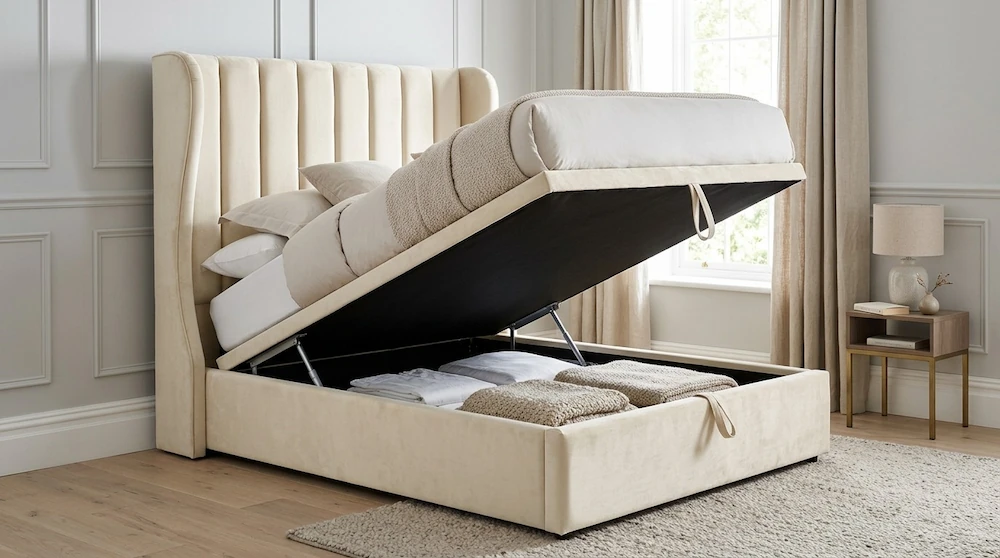
Quick answer Start with your room. If you have roughly 60cm of clear floor at the foot of the bed, an end-lift ottoman gives the easiest access. If the foot sits against a wall or wardrobe, choose side lift. Then match the gas struts to your mattress weight, pick a solid or slatted base, and confirm the UK size in centi-metres.
Key takeaways
- Room first, bed second. End lift needs about 60cm clear at the foot. Side lift needs one long side free.
- Struts must suit the mattress. Foam mattresses usually weigh 20–30kg, pocket sprung 30–45kg and pillow tops 45–60kg or more.
- Know the height. Our slatted ottoman base is 30cm and our solid divan ottoman base is 33cm, before you add the mattress.
- Store light and bulky. Duvets, coats and empty suitcases are ideal. Books and toolboxes are not.
- See the fabric first. Order free samples before you buy, because colour and texture look different on screen.
Most people who ring our workshop about an ottoman bed are not really asking about beds. They are asking about space. The spare duvet has nowhere to live, the suitcases are on top of the wardrobe, and the box room has to work as a bedroom, an office and a store cupboard. An ottoman bed solves that well, but only if you pick the right one for your room and your mattress.
We build ottoman beds by hand in Batley, so we see what goes right and what goes wrong. This guide covers the decisions that matter: which way it lifts, how strong the struts need to be, which base to choose, what size fits your room, and what you should and should not keep underneath.
What is an ottoman bed and how does it work?
An ottoman bed is a bed whose whole base lifts up to reveal one large storage compartment underneath the mattress. Instead of drawers that only use part of the space, you get the full footprint of the bed, closed in on all sides so dust stays out.
Gas-lift struts, explained simply
The lifting is done by gas struts, the same idea as the struts that hold up a car boot or bonnet. Each strut is rated in newtons (N), which is the amount of force it pushes with. A higher rating lifts a heavier mattress. When the struts are matched properly, the base rises smoothly with one hand and stays open while you rummage. When they are too weak, you end up holding the mattress up with your shoulder.
Bedstead ottoman or divan ottoman?
A bedstead ottoman is an upholstered frame, often with a tall headboard and a footboard, with the lifting platform built inside it. A divan ottoman is a box-style base that sits low and neat, usually paired with a separate headboard. Bedsteads make more of a statement in the room. Divans are compact and suit tighter spaces. If you are weighing up drawers instead of a lift-up base, our guide to divan storage beds covers that side of things.
Are ottoman beds worth it?
For most UK bedrooms, yes. Homes here are getting smaller, and an ottoman bed adds storage without adding a single piece of furniture. That is why searches for ottoman beds have stayed high and are still climbing, particularly for king size frames.
What you gain
- The most storage of any bed type. The entire area under the mattress becomes usable.
- A tidier room. Bulky things disappear from view, and there is no gap under the bed collecting dust.
- One purchase instead of two. You may not need a chest or blanket box at all.
What to be honest about
- You lift the mattress to get in. Good struts make this easy, but it is still slower than opening a drawer for things you need every day.
- They are heavier to move. Worth knowing if you rent and move often.
- They cost more than a basic divan. You are paying for the lifting mechanism and a stronger frame.
Should I choose a side-lift or end-lift ottoman bed?
This is the question we get asked most, and the answer almost always comes down to where the bed will stand.
How to measure your room
Draw a quick plan or mark it out with masking tape. An end-lift ottoman opens from the foot, so you need roughly 60cm of clear floor at the end of the bed to stand and reach in, a figure Bedstar also recommends in its own guidance. A side-lift ottoman opens from one long side, so that side needs similar clearance. Check where the door swings, where the radiator sits and whether a wardrobe door will clash with the open base.
| Usage | Side-lift ottoman | End-lift ottoman | Divan with drawers | Frame + under-bed boxes |
|---|---|---|---|---|
| Space needed | One clear long side | About 60cm at the foot | Room for drawers to pull out | Clearance under the frame |
| Best for | Narrow rooms, foot against a wall | Freestanding beds, king and super king | Things you use daily | Tight budgets |
| Storage | Full footprint, enclosed | Full footprint, enclosed | Drawer space only | Open, collects dust |
| Watch out for | Far side harder to reach | Blocked by a bench or chest | Less total volume | Boxes on show |
How heavy a mattress can an ottoman bed lift?
This is where cheap ottomans let people down. The frame looks fine in the photos, but the struts were chosen for a light foam mattress. Put a heavy pocket-sprung or pillow-top mattress on it and the base either will not stay up or slowly drifts down on your head.
Typical mattress weights
As a rough guide for a double:
Larger sizes weigh more.
Slatted or solid base: which ottoman base should I choose?
Both work well with standard UK mattresses. The difference is feel and height.
Solid divan ottoman base
A firm platform with nothing to flex or creak. A good choice if you like a supportive feel or have a heavy pocket-sprung mattress.
Slatted ottoman base
Slightly lower, with a touch more give and better airflow under the mattress.
Normal (non-storage) base
For comparison, if you decide you do not need storage after all.
To work out the finished height of the bed, add your mattress depth to the base height. A 25cm mattress on a 33cm divan ottoman base gives a sleeping surface of about 58cm.
If a frame does start to creak after a house move, our guide to fixing a squeaky bed walks through the usual causes.
What size ottoman bed do I need?
UK bed sizes are measured differently from European and US sizes, so always check the centimetres rather than the name. The National Bed Federation notes there is no legal size standard in the UK and the accepted industry tolerance is plus or minus 20mm, which is worth knowing if you are matching an existing mattress.
| Size | Mattress size (cm) | Width per person | Typical strut guide (bedstead) |
|---|---|---|---|
| Single | 90 × 190 | One sleeper | Ask the maker |
| Small double | 120 × 190 | 60cm | Ask the maker |
| Double | 135 × 190 | 67.5cm | 2 × 900N |
| King | 150 × 200 | 75cm | 2 × 1100N |
| Super king | 180 × 200 | 90cm | 2 × 1350N |
Remember that the frame is bigger than the mattress. An upholstered headboard adds 13–25cm of depth on our beds, and a footboard and side rails add width and length. Measure the whole footprint, then leave room to open the base.
You can browse the full range in our luxury ottoman beds collection.
Which fabric is best for an ottoman bed with kids or pets?
Plush velvet
Plush velvet is soft and hard-wearing, and the short pile is easy to brush down.
Crushed velvet
Crushed velvet has a light-catching finish that hides small marks well, which is partly why it has become so popular this year.
Teddy bouclé
Teddy bouclé looks wonderfully cosy but its loops can catch on claws, so it suits homes without cats.
For more detail, see our guide to choosing bed fabric, then order free fabric samples to see and feel them in your own light.
How do I choose an ottoman bed? A six-step checklist
Frequently asked questions
Are ottoman beds worth it?
For most UK bedrooms, yes. An ottoman turns the whole space under the mattress into one enclosed compartment, which suits bulky items such as spare duvets, suitcases and winter coats. The trade-offs are a higher price than a basic divan, a heavier frame to move, and lifting the mattress whenever you need something.
Side lift or end lift: which is better for a small bedroom?
Side lift usually suits small bedrooms where the foot of the bed sits against a wall, radiator or wardrobe, as long as one long side is clear to stand at. End lift suits rooms with roughly 60cm of clear floor at the foot and gives easier reach on king and super king beds.
How heavy a mattress can an ottoman bed lift?
It depends on the gas struts. Well-made ottomans with strong struts lift heavy pocket-sprung mattresses easily, while cheaper frames fitted with light struts may struggle. As a guide, foam mattresses weigh 20–30kg, pocket sprung 30–45kg and pillow tops 45–60kg or more. Always compare your mattress weight with the maker’s stated limit.
What do newton ratings on gas struts mean?
The newton (N) figure shows how much force each strut pushes with, so a higher rating lifts a heavier mattress. A common UK rule of thumb is around 2×900N for a double bedstead ottoman, 2×1100N for a king and 2×1350N for a super king. Divan-style ottoman bases usually use four struts instead.
How tall is a Dreamland Bedz ottoman bed?
It depends on the base. Our slatted ottoman base is 30cm high and our solid divan ottoman base is 33cm, compared with 25cm for a standard base. Footboards are 50cm. Add your mattress depth, usually 20–30cm, to work out the finished sleeping height.
What should I not store in an ottoman bed?
Avoid heavy, dense items such as books, tools or packed suitcases, which add weight the struts were not designed for. Keep worn shoes away from bedding to stop musty smells, and use breathable bags or lidded boxes. Seasonal duvets, spare pillows, towels, wrapping paper and empty luggage are ideal.